





















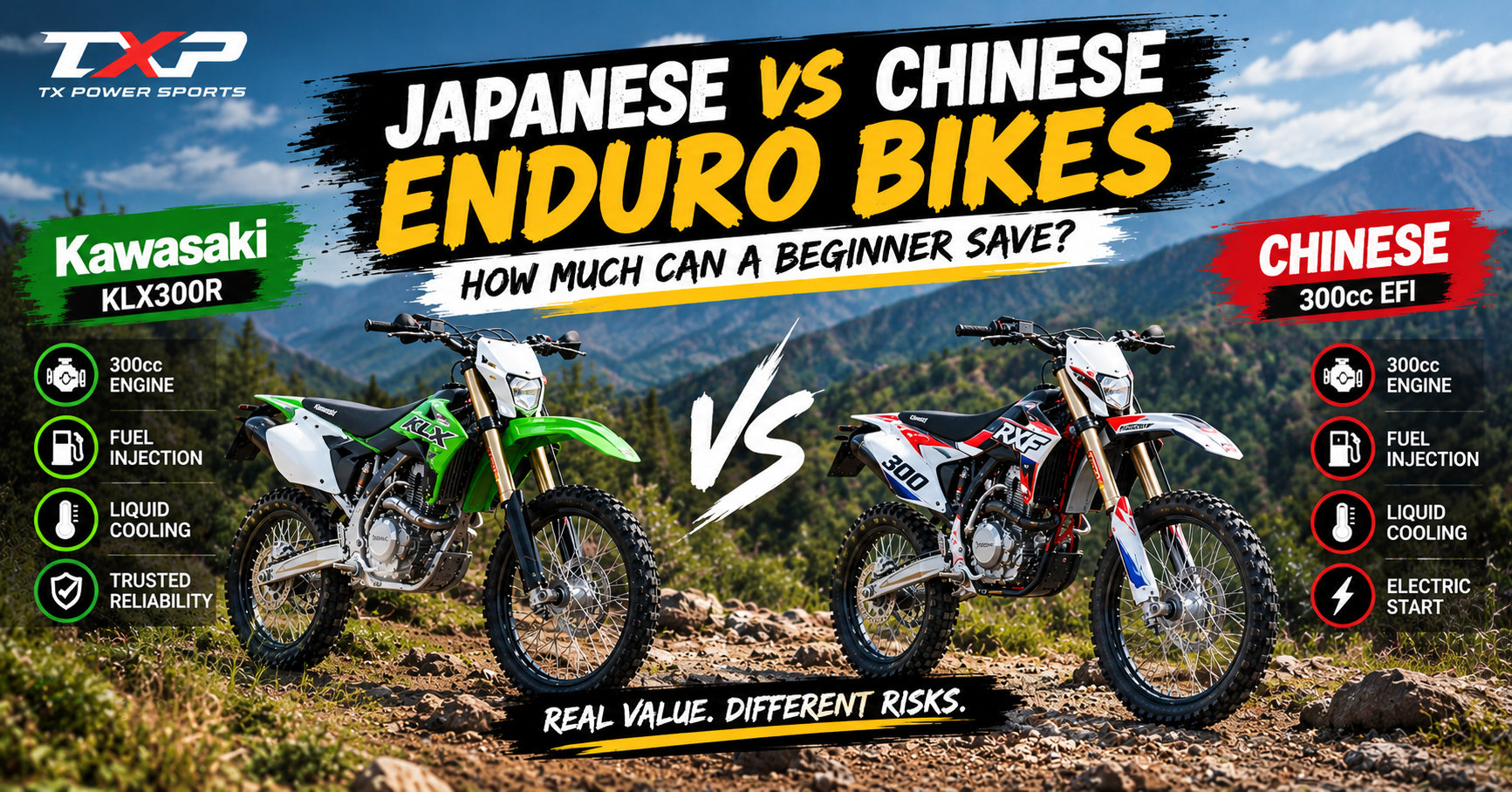
You’ve got about $3,000 to spend and the bike you actually want is nearly double that.
Meanwhile, there's a Chinese 300 with fuel injection and liquid cooling sitting there at half the price and you're wondering what the catch is.
There is one. It just isn’t where most people look for it.
Against a Kawasaki KLX300R, a Chinese bike saves you roughly $2,000 to $2,850, and the spec sheet holds up better than you expect.
What you lose is history. No one's been riding these models for years and recording all the things that go wrong with them. So if something breaks, you're pretty much on your own.
Whether that's a fair trade is down to you, so let's go through it.
Let’s Do The Money First
TX Power Sports has the Vitacci DB-K8 300 EFI at $2,899.95, the TrailMaster LX300 at $3,549 and the TrailMaster TM38EX at $3,699.95.
Kawasaki's 2026 KLX300R has a MSRP of $5,749. That's a saving of approximately $2,200 on the KLX300, $2,050 on the TM38EX and $2,850 on the DB-K8 (which is roughly half the price of the Kawasaki).
However, these are sticker prices and the price on the tag isn’t what you’ll always pay. Here’s an example.
A bike is tagged at $5,000. The shop adds $600 for shipping and $400 for paperwork. You pay $6,000 before tax. Chinese bikes work the same way. A bike tagged at $3,000 can also come with extra charges for shipping and setup, so you might pay $3,500.
Every shop does fees differently, so always ask for the real total before you decide.
The Yamaha TT-R230 is the hardest to pin down because dealers price it all over the place. New 2026 bikes are listed anywhere from $4,116 to $5,189. If you see $4,699 somewhere, that’s one dealer’s price and not a rule.
What You Get On Paper
On paper, the Chinese bikes look good. The LX300 has a Zongshen 283cc liquid-cooled, fuel-injected engine that is claimed to make 23hp. The TM38EX has a 298cc engine of the same type, claimed at 31hp. The Kawasaki KLX300R has the same technology, with a 292cc engine.
A lot of people think the Yamaha must be better equipped just because it costs more than the Chinese bikes.
It isn’t.
The TT-R230 has a 223cc air-cooled engine, a carburetor and a 130mm drum brake at the rear. It does have electric start and six gears.
But you don’t get fuel injection, liquid cooling, or a strong rear brake. That extra $1,800 over the DB-K8 is really just buying you a simpler bike that’s been around forever.
Seat Height Matters More Than Horsepower
If you’re just starting out, seat height will matter way more in your first month than how much power the bike has.
The LX300 PRO has a 37.4-inch seat and weighs 266 lb. The KLX300R’s seat is 35.4 inches, and it weighs 282 lb at the curb. The TT-R230 is the lowest and lightest at 34.3 inches and 251 lb.
3 inches between the Yamaha and the LX300 is a big deal. On a hill or awkward spot, it can mean the difference between catching yourself or just slowly falling over.
Sit on any bike you’re thinking about, and if you’re up on your toes, it’s probably not the one for you.
What The Extra Money Buys You
With a Yamaha or Kawasaki, you’re really paying for all the stuff around the bike. People have written up every fix, most mechanics know them, and you can find parts pretty easily.
You probably won’t find much info on how long the engines or gearboxes last on the Chinese bikes. That doesn’t mean they’re bad, just that nobody really knows yet, so be careful if someone says otherwise.
Always read the warranty before you get too excited about the brand.
The TT-R230 comes with a 90-day limited factory warranty, which is short. TX Power Sports’ published policy gives different coverage periods for engine and transmission parts, leaves out a lot of labor costs, and warns that some overseas parts orders can take up to 8 weeks. Ask seller:
- Who pays shipping on a warranty part?
- Does the warranty cover local labor?
- What happens if the part you need is backordered?
If you’re buying outside the US, a US warranty won’t help much unless you can actually get parts and service where you live, so check that first.
With the DB-K8, make sure you know exactly which engine it has and where the electrical bits come from. Two bikes can both be 300cc but have nothing else in common. The engine code is what you’ll need if you want to get parts from somewhere other than the seller.
Count The Whole Cost
Add up what you’ll actually pay to get the bike home, plus your gear and a bit set aside for repairs. Then think about what you could sell it for in a few years.
Gear costs the same no matter which bike you pick, so if you save $2,000, you can put that into a better helmet, boots, or tools. Keep some aside for repairs, especially if you’re going with a bike that doesn’t have as much support.
Resale is the one number we can’t give you.
Japanese bikes are usually easier to sell because people know them and trust that they can get parts. A less common bike might take longer to sell. Check your local used listings for a couple-year-old version of each and see what they’re actually going for.
Which Bike For Which Rider
- Yamaha TT-R230: For a shorter or nervous beginner who wants something with a long history behind it.
- Kawasaki KLX300R: For someone who wants more power and a deep support network, and can afford the premium.
- TrailMaster LX300: For a budget-minded rider who doesn’t mind some wrenching and has checked parts and local repair options first.
- TrailMaster TM38EX: For an experienced rider who wants the most claimed power for the money. It has lights, mirrors and indicators.
- Vitacci DB-K8 300 EFI: For the tightest budget, once you’ve confirmed the engine, the parts supply and the warranty terms.
These aren’t equivalent bikes, so choose by your size, your skill and the terrain you ride, not by engine displacement.
Before You Hand Over Any Money
Make sure you get four things in writing:
- The out-the-door price
- The exact engine model number
- The warranty terms for the engine and transmission
- And a realistic lead time for common parts like filters, brake pads and sensors.
If a seller can’t give you all that, it’s better to walk away and look somewhere else.