





















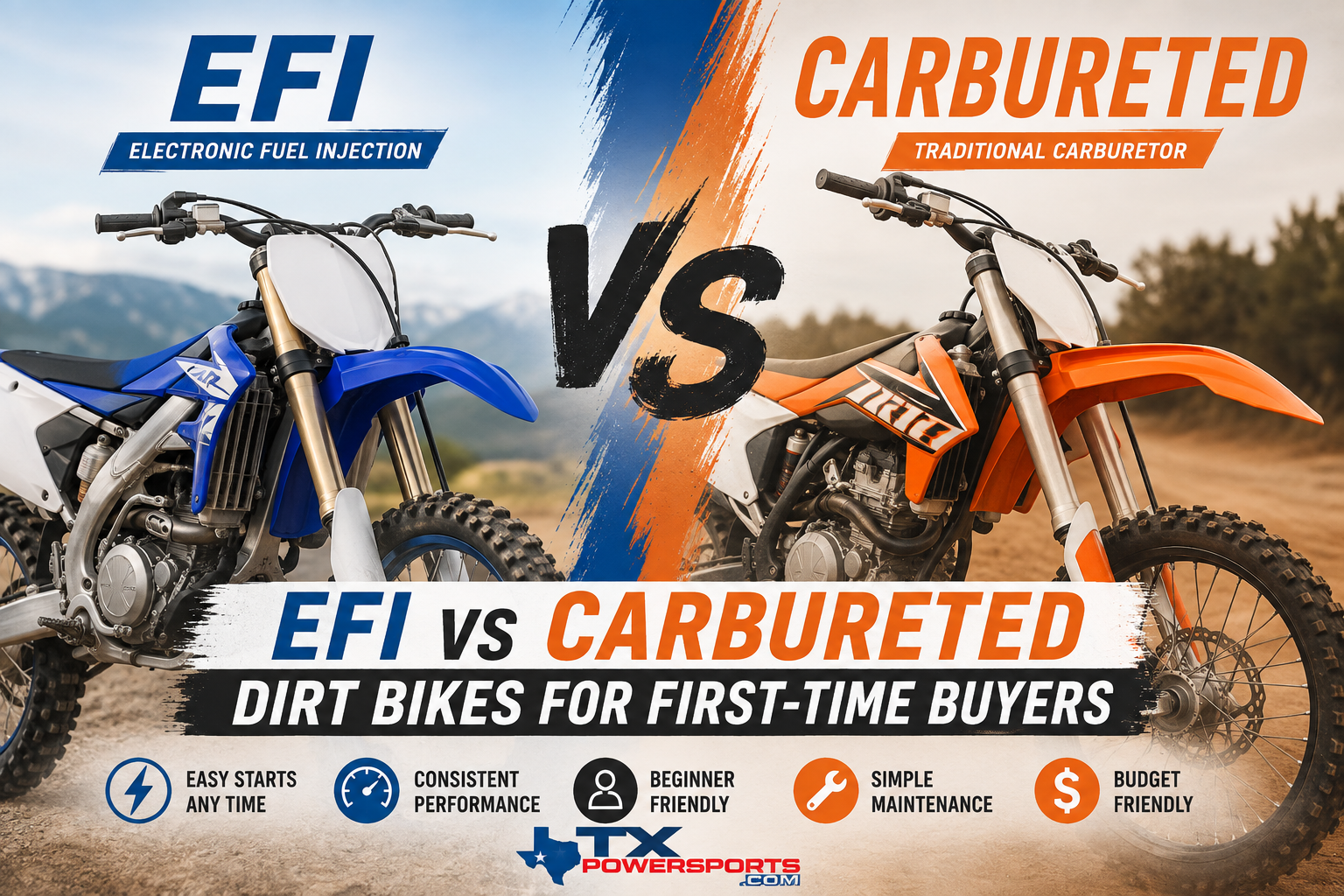
So, you're buying your first dirt bike. EFI or carb? One guy tells you EFI is easier. Another swears a carb is simpler, cheaper, and easier to fix. Both sound pretty convincing.
So who's right? Well, it depends on how and where you're going to ride. Let's look at two real bikes to make the decision a little easier: the Vitacci DB-K8 300 EFI and the Apollo DB-36 250 from TX PowerSports. They're both full-size dirt bikes, but they go about things pretty differently.
Here's what you really need to know before you spend your money.
How EFI and Carburetors Work
Let's get the technical stuff out of the way first. EFI means electronic fuel injection. Instead of using a carburetor to mechanically meter fuel into the engine, an EFI system uses an ECU (engine control unit), injector, and sensors to figure out how much fuel the engine needs. A carburetor does the same basic job mechanically.
That's the big difference.
With EFI, the bike handles more of the fuel management for you. With a carb, you're more involved. Neither system is magic. Neither one is automatically better. They just put more of the work in different places. And that matters when you're new to dirt bikes.
You're already learning clutch control, throttle control, shifting, braking, body position, and how quickly a bike can get away from you when you grab too much throttle. If the bike can take one more thing off your plate, that's not a bad deal.
Why EFI Is Easier for Beginners
This is probably where you'll notice EFI first. Imagine a Saturday morning. Your buddies are already texting that they're leaving in 20 minutes. You unload the bike, hit the starter, and head out.
That's the appeal. A modern EFI system can manage fueling during startup and changing conditions without asking you to manually manage the mixture the way a carbureted bike can. A carb isn't necessarily hard to start. Once you know the bike, you get the routine down. Maybe the choke goes on. Maybe it needs a little throttle. Maybe you let it warm up for a minute.
No big deal.
But when you're brand new, that's one more little dance to learn. And you've already got enough going on. EFI also becomes more useful when the elevation changes. A carburetor doesn't automatically know you've taken the bike from low elevation to several thousand feet in the mountains. Changes in air density can affect how the engine runs, and significant altitude changes can make carburetor jetting relevant.
EFI can compensate for changing conditions much more effectively. That doesn't mean an EFI bike makes the same power at high altitude. It can't. There's still less oxygen in the air. What it means is that the fuel delivery can stay better matched to the conditions without you having to start changing jets.
If you mostly ride the same trails around home, you might never care much about that. But if you throw the bike in the truck and chase riding spots all over the place, you'll probably appreciate it.
Why Carbs Still Make Sense
Now let's not beat up on carburetors. They're not some ancient technology that belongs in a museum. A good carbureted dirt bike can run great. There's something pretty satisfying about a carb.
t's mechanical. You can understand it. You can take it apart, clean it, change jets, adjust it, and actually see how the changes affect the engine. For somebody who likes working on motorcycles, that's half the fun. You might start learning about pilot jets and main jets. Then mixture screws. Then jet needles. Then you start figuring out what the engine is telling you when it runs rich or lean. Before long, you're not just riding the bike. You understand what's going on under the seat.
That's a pretty useful skill.
The catch is that a carburetor can require more involvement. If the bike isn't running right, you may have to figure out why. Maybe it needs different jetting. Maybe altitude is throwing it off. Maybe the pilot circuit needs attention. For some people, that's no big deal. For others, the thought of tuning a carb before a Saturday ride is enough to make them reach for the EFI model.
You Might Also Want to Check: 150cc dirt bike for sale under $1000
EFI Has More Technology
Here's the funny part. EFI is actually the more complicated system. You've got an ECU, fuel pump, injector, sensors, wiring, connectors, and other electrical components doing their jobs behind the scenes.
But you don't have to think about most of that when everything is working properly. That's the whole point. The complexity is there so the rider doesn't have to deal with as much of it. A carburetor is simpler mechanically, but that simplicity puts more responsibility on you. That's why you'll hear two completely different opinions from riders who have owned both.
One guy says, "Give me a carb. I can fix that thing anywhere."
Another says, "Give me EFI. I just want to ride."
Neither guy is wrong. They're just valuing different things.
The DB K8 and Apollo Are Different Bikes
This is where the comparison gets interesting. Don't look at the Vitacci DB-K8 300 EFI and Apollo DB-36 250 and think you're simply comparing an EFI bike against a carbureted bike.
You're not.
They're different machines. TX PowerSports lists the DB-K8 with a 297cc single-cylinder engine, liquid cooling, EFI, electric start, and a six-speed manual transmission. It has 21-inch front and 18-inch rear wheels and a net weight of 273.4 pounds. The Apollo DB-36 uses a 229.2cc single-cylinder engine, air cooling, a Jinke carburetor, electric and kick start, and a five-speed transmission. It also runs 21-inch front and 18-inch rear wheels, but its net weight is 237.6 pounds.
So you're looking at a pretty meaningful difference:
- 297cc versus 229.2cc
- Liquid-cooled versus air-cooled
- 6 speeds versus 5
- EFI versus carb
- 273.4 pounds versus 237.6 pounds
That's why it would be a mistake to say the DB-K8 is simply better because it has EFI. There's a lot more going on.
The DB-K8 Is the More Powerful Package
The DB-K8's bigger engine is a big part of the story. TX PowerSports lists the DB-K8 at 19.5 kW maximum power and 23.5 N·m maximum torque. The Apollo is listed at 11.5 kW and 17.5 N·m. That's a pretty substantial difference. And EFI doesn't get all the credit for that. The DB-K8 has more displacement, liquid cooling, different gearing, and a more performance-oriented engine package.
So if you're looking at the DB-K8 because you want more motor, that's completely fair. Just don't tell yourself you're spending more money solely to get EFI. You're buying a more capable overall machine.
The six-speed transmission is part of that too. More gears don't automatically make a dirt bike better, but having another ratio can give you more flexibility when you're moving between slower trails and faster sections. The liquid cooling adds complexity, too, but it gives the engine a more controlled operating temperature under demanding conditions. That's the general tradeoff here. You get more capability, but you also get more going on.
The Apollo Has Some Real Advantages
The Apollo shouldn't get dismissed just because it has a carb. For starters, it's lighter on the listed specifications. At 237.6 pounds, it's about 36 pounds lighter than the DB-K8. If you've never owned a dirt bike, you might think 36 pounds isn't a big deal.
It is.
You'll feel it when you're moving the bike around the garage. You'll feel it when you're loading it into the truck. You'll feel it when you're trying to turn around on a tight trail. And you'll definitely feel it when you drop the bike. Because eventually, you will.
Everybody does.
The Apollo also has a slightly lower listed seat height at 35.4 inches compared with 36.22 inches for the DB-K8. That doesn't turn it into a small bike, but for some newer riders, those little differences can make the bike feel a little easier to manage. Then there's the starting system.
The Apollo has both electric and kick-start. So no, buying the carbureted bike doesn't mean you're signing up to kick-start it every single time. You've got the button. And the kick starter is there when you want or need it.
You Might Also Want to Check Our Collection of: 250cc dirt bike
The Price Difference Matters
This is where the conversation gets real. TX PowerSports currently lists the DB-K8 at $2,899.95 MSRP and the Apollo DB-36 at $1,998.95 MSRP. That's roughly a $901 difference. It's easy to look at that and think you're paying $900 for EFI.
You're not.
You're paying for a different motorcycle. The DB-K8 also gives you the larger engine, liquid cooling, six-speed transmission, higher listed output, and a more performance-focused overall package.
So the question isn't really: Is EFI worth $900?
The better question is: Is everything the DB-K8 gives you worth roughly $900 more?
And don't forget about everything else you're going to spend money on. A first dirt bike isn't just the bike. There's a helmet, boots, gloves, goggles, riding gear, oil, filters, chain lube, and tools. Maybe spare tubes as well. And you'll need some way to get the bike to the riding area unless you're lucky enough to have trails right outside your door.
So, don't blow the entire budget on the motorcycle and then cheap out on the stuff that keeps you safe and keeps the bike running.
What Ownership Really Looks Like
This is where both sides of the EFI-versus-carb argument can get a little silly. EFI doesn't mean maintenance-free. And owning a carbureted bike doesn't mean rebuilding the carb every weekend. Both bikes still need the usual dirt-bike attention.
Oil needs changing, air filters need cleaning, chains need adjustment and lubrication, brakes need checking, tire pressures matter, fasteners need attention, and suspension needs inspection. And if you're riding in dust and mud, the bike needs to be cleaned. A fuel-injection system doesn't care whether you washed the bike, but the engine still does.
So think of EFI as less fuel-system fuss, not less maintenance overall. Because you're still going to turn wrenches. You're still going to get dirty. And if you ride hard, you're eventually going to replace things. That's just part of owning a dirt bike.
Who Should Buy the DB K8
The DB-K8 makes sense for the first-time buyer who wants a more capable bike and doesn't want fuel-system tuning to become part of the hobby.
- You want to hit the button and ride.
- You don't want to worry much about jetting.
- You may ride at different elevations.
- You may travel to different riding areas.
- You want more engine.
- You like the idea of liquid cooling and six-speed gearing.
- And you're comfortable spending more for the whole package.
In that case, the DB-K8 is a pretty compelling option. The EFI is nice, but it's the combination of EFI, 297cc displacement, electric start, liquid cooling, and six-speed gearing that makes the bike interesting.
Who Should Buy the Apollo
The Apollo makes sense for a different kind of first-time buyer. It’s for you if you are:
- Trying to keep the purchase closer to $2,000.
- Mostly riding local trails.
- Perfectly happy learning how a carb works.
- Maybe you actually enjoy wrenching.
- You'd rather have a lighter bike and keep some money in your pocket.
In that case, the DB-36 has a pretty solid argument. You still get an electric start; you get a full-size platform. And you get a simpler, lighter, lower-cost package without giving up the basic dirt-bike experience.